Wednesday, February 23, 2011

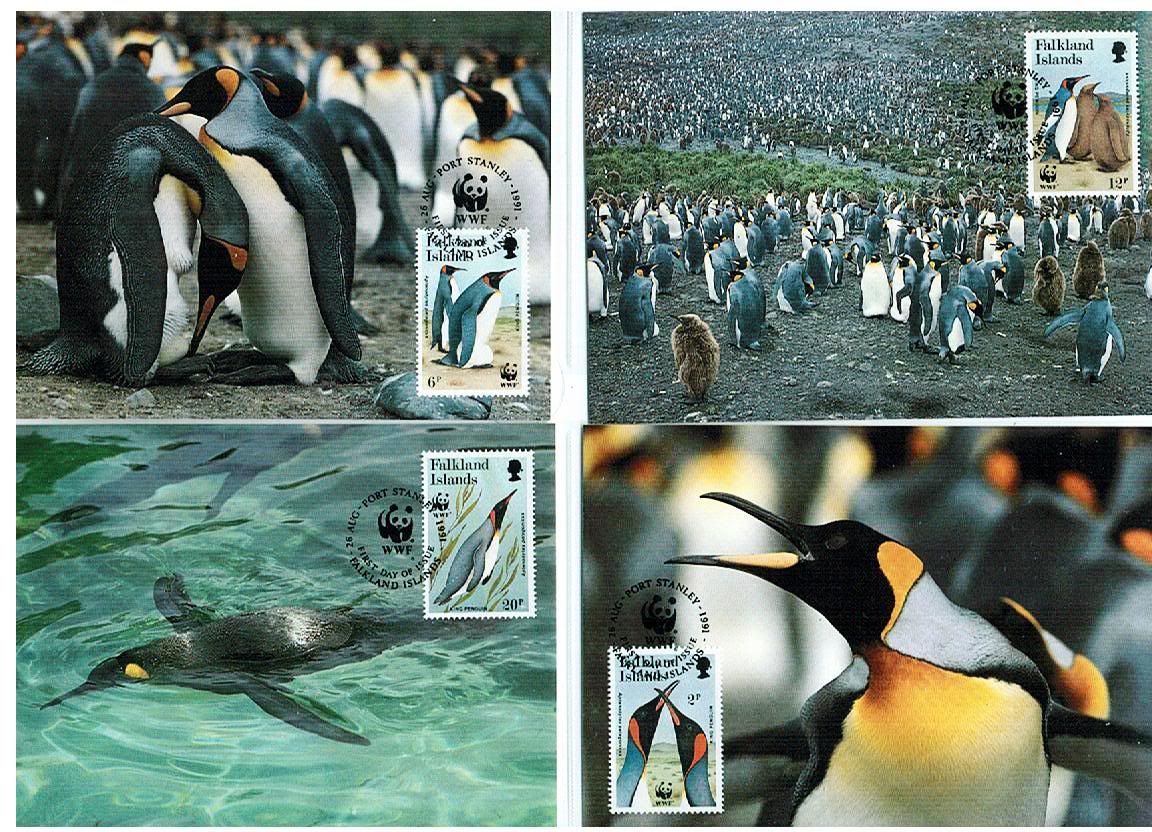
My fellow Americans: ask NOT what your country can do for these tens of thousands of PENGUINS; ask what your country CAN do for these tens of thousands of your fellow Americans [from Wisconsin and more states - The Union Revolution? Watch it, be aware and beware...] forced to defend their right to unionized labor, against corporate abuse. Just as a 'ricochet' visual metaphor: WWF maxicards from the Falkland Islands - The King Penguin ((Aptenodytes patagonicus))

"The King Penguin (Aptenodytes patagonicus) is the second largest species of penguin at about 11 to 16 kg (24 to 35 lb), second only to the Emperor Penguin."
http://en.wikipedia.org/wiki/King_penguin


Don't read now too much about the penguins.
As I said, the images that I provide here are just as a 'ricochet' visual metaphor for The Union Revolution, which may happen "unbeknownst to you", if you are the unsuspecting, average Joe Sixpack from USA.
Maybe you're not.


The metaphor is about tens of thousands of individuals that come together for a cause, because their [instinct?] belief is that their survival depends on this.
This is a cause for concern. Smile if you want, but don't laugh it away.


I'll repeat, in case you overlooked it:


Ask NOT what your country can do for these tens of thousands of PENGUINS; ask what your country CAN do for these tens of thousands of your fellow Americans [from Wisconsin and more states - The Union Revolution? Watch it, be aware and beware...] forced to defend their right to unionized labor, against corporate abuse.

"In Wisconsin, State police have been sent to apprehend Wisconsin senators who have left the Capitol building and force them to participate in the legislative session, in order that quorum be satisfied.[15] The Governor of Wisconsin, Scott Walker, said that he would call the National Guard, a military reserve force in the US[37]."

[edit]
Read more: 
http://en.wikipedia.org/wiki/2011_Wisconsin_budget_protests


If "Walker, Wisconsin Ranger" thinks that he can go home Scot-free, after unleashing The National Guard upon the huge crowd of protesters, then he may be in for an awakening of the rude kind.

If Walker needs air-superiority support to supplant the NG, he better hurry-up and ask Gaddafi for help - he still has a few fighter jets available.
Gaddafi has just said: "Don't listen to the dogs!"

Upcoming famous last words will be: "Who let the dogs out? Who?...Who?"

But don't quite laugh: smile, if you have to, then seriously think about it.

=================

Please visit and join The World Bird Wednesday meme!


Shabbos, shabbos! in an English literary journal of 1860.

Toward the end of 1859, Marcus Heinrich (or Hyman) Bresslau, former editor of the London Jewish Chronicle, decided to make a go of his own Jewish literary periodical in English. The first issue of המאסף The Hebrew Review and Magazine For Jewish Literature appeared on October 21, in time for Simchas Torah 5620. It called itself a "New Series," since Bresslau viewed it as a continuation of the original Jewish literary periodical Hameasseph, which gave it its Hebrew name, as well as the short-lived גלאד The Hebrew Review and Magazine of Rabbinical Literature, a similar journal published by Morris Raphall in 1834-6, and which Bresslau was himself involved. Both of these periodicals contained many interesting original essays and translations of classic and not so classic material.

In the introduction in the first issue, Bresslau notes that at the time there are three French journals. There are journals in Italy, Russia and Turkey. In America there were four journals, two in English and two in German. Deploring the fact that England could not boast even one Jewish journal, he proposes that this will be remedied. Although it would feature original material, he also planned to feature translations of numerous works, a partial list of which includes portions of:
  • Moreh Nevuchim by Maimonides
  • Chovos Ha-levavos by Rabbi Bachya
  • Menoras Ha-meor by Rabbi Isaac Abohab
  • Binah Le-ittim by Rabbi Azariah Figo
  • Kuzari by Rabbi Judah Halevi
  • Meor Enayim by Rabbi Azariah de Rossi
and so forth. The Review also serialized parts of Zunz's Zur Geschichte und Literatur, as well as the first two parts of Mendelssohn's very interesting introduction to the Torah, the Or Le-nesiva.

In August of 1860 (toward the end of the run of Bresslau's journal) the following witty blurb was printed (presumably written by Bresslau) hoping that Jewish business owners will close their stores entirely on Shabbat in keeping with "resolution number 4 unanimously passed at Mount Sinai." Below is his statement as well as three subsequent replies printed in the journal (over three separate issues, but I put them all together). Two people hoped that these storekeepers will observe the sabbath personally, and not only keep their stores closed:

Lions and lambs.

This 1896 reaction to a suggestion to merge Christmas and Hanukkah into one big, happy American July 4th holiday comes courtesy of a periodical called The Freethinker.


So I got to thinking about lions and lambs.

I remember the first time I heard the following joke, in the pages of the Jerusalem Post, I think, perhaps 10 years ago:
The Biblical Zoo in Jerusalem arranges an exhibit displaying Messianic times, the centerpiece being a cage with a lion and lamb peacefully co-existing. Visitors are amazed, and one in particular decides he simply must find out who is responsible for this miracle. With some inquiries he learns that, of all people, the talented zoo keeper is none other than Henry Kissinger. He seeks out Kissinger and asks, "By God, how do you do it? I've never seen anything like it." And Kissinger answers, in his trademark monotone deadpan: "Every day - a new lamb."
And hilarity ensues.

Since then I saw it written a little differently in Cold War-era memoirs and policy books from the 1970s. This time, instead of a fable about Kissinger and realpolitik, it was presented as an old Russian joke/ parable. Of course it was.

Knowing how these things work, I decided to trace it a little further. It's really quite extraordinary how today a great deal can be accomplished in searching online for the history of aphorisms and jokes in only a few minutes. Of course I wouldn't write a book about it with only a preliminary research, but in no time at all I learned that the joke appears in several stages. In the early 1930s it was used in certain American sources, warning that the United States needs to be militarily ready and alert to the dangers of the world. In the 1950s it is already a parable about the Cold War, by the 60s it is said to be Russian in origin (although in one version, an Israeli visits a zoo in Moscow), and by the early 1970s (pre-Yom Kipper War) it seems to have become a Kissinger joke in Israel, which probably no one found funny. By the late 1970s an American policy insider is using it in his memoir. In a book of humor from 1992, it is about China.

But I found an 1918 telling of the joke in which the zoo keeper is none other than P.T. Barnum. An Irishman is quoted telling the story and then he clarifies that it "'Twas not in a Sunday School lesson, but in Barnum's circus, years ago. Th' trouble was, howiver, that ole man Barnum had t' put in a new lamb ivery marnin'. They laid down togither, all right, but th' lamb was on th' inside."

And then a more genteel telling of the tale, from a 1922 lecture on education by a president of Purdue University:
It is related that, during the heyday of his prosperity and prominence, P. T. Barnum, of lamented circus memory, had under his tents a very wonderful collection of animals. They had been assembled from all climes and all countries. There was the lion, the leopard, the tiger, the bear, the wolf, the fox and many others. This unique animal family also numbered among its members a fine, woolly lamb. One day a group of distinguished visitors came to the circus. It was an important group and Barnum himself acted as an escort through the menagerie. Naturally, the particular animal family was exhibited with high pride. This family represented the finest of the animal kingdom and the results of the highest animal education. Here was proof of what human skill and kindness could accomplish with even the most belligerent of beasts. Concord and peace was the rule of the family. As in every gathering of humans there was one doubter among the distinguished visitors. He inquired of Mr. Barnum how long the animals had lived together in amity. He was informed that the family had been on exhibit for nearly three years. "Do you mean to tell me that that lamb has been a member of this family all this time?" said he to the greatest show man on earth. Mr. Barnum, hesitating for a moment, said with a smile, "Of course, you realize that we are obliged to renew the lamb from time to time." (Laughter).

If you will pardon the impudence, I would suggest that the junior college is the new lamb which has been brought into our happy family of education. Just how long the junior college is going to last before it is benevolently absorbed by other institutions, may be considered a fair and open question.
Perhaps in other languages the joke is older - maybe even Russian.

Incidentally, as far as I can tell the aforementioned Rabbi Dr. Krauskopff of Philadelphia didn't really suggest a merger of Judaism and Christianity based on Americanism, with July 4th as the national religious holiday. But he was a big fan of Christmas. You can read his ma'amar on Christmas, delivered on Sunday, Dec. 27, 1891 here. This became sufficiently well known that nearly 20 years later, when New York Jews were accused of waging a war against Christmas in the public schools, several Christian periodicals approvingly cited some of his remarks, omitting, of course all the stuff he said about its pagan origin.

PS I already know that the lion does not lay down with the lamb in the Bible, or in Moscow, or in Jerusalem.

Tuesday, February 22, 2011

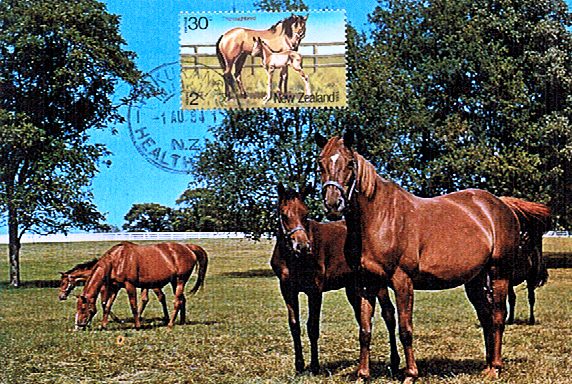
Insurance industry says earthquakes are 'acts of God'. BBC: 'New Zealand earthquake: 65 dead in Christchurch'. What's in a name, like Christchurch? Nothing but wishful thinking?... 'for Christ's sake'? Also, a maximum card from New Zealand, otherwise a beautiful country, whose green scenery you should remember from 'Lord of the Rings' movies.

Read from BBC:
'New Zealand earthquake: 65 dead in Christchurch'
http://www.bbc.co.uk/news/world-asia-pacific-12533291

==============
Maximum card/ maxicard/ dorincard from New Zealand.

Christchurch, under assault from the TeCtonic Knights?


If you will never come around to reading the whole article about New Zealand, at least read this, will you? :)
"New Zealand is an island country in the south-western Pacific Ocean comprising two main landmasses (the North Island and the South Island) and numerous smaller islands, most notably Stewart Island/Rakiura and the Chatham Islands. The indigenous Māori name for New Zealand is Aotearoa, commonly translated as land of the long white cloud. The Realm of New Zealand also includes Tokelau; the Cook Islands and Niue (self-governing but in free association); and the Ross Dependency, New Zealand's territorial claim in Antarctica.
New Zealand is notable for its geographic isolation: it is situated about 2,000 kilometres (1,200 mi) southeast of Australia across the Tasman Sea, and its closest neighbours to the north are the Pacific Islands of New Caledonia, Fiji and Tonga. 
The country's sharp mountain peaks owe much to the earthquakes and volcanic activity caused by the clashing Pacific and Indo-Australian Plates. 
The climate is mild and temperate and most of the landscape is covered by tussock grass or forests of podocarp, kauri or southern beech. 
During its long isolation New Zealand developed a distinctive fauna dominated by birds, a number of which became extinct after the arrival of humans and introduced mammals."

A Romney shiquolt and lambs.
An image with Romney lambs.
In German: Ein Bild mit Romney Lämmer.

Mitt Romney:
"Willard Mitt Romney (born March 12, 1947) is an American businessman, and a Republican who was the 70th Governor of Massachusetts from 2003 to 2007, was a candidate in the 2008 U.S. presidential election, and is a likely candidate in the 2012 presidential election."

Monday, February 21, 2011

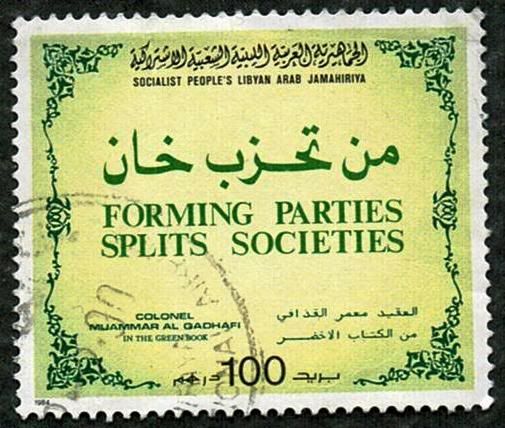
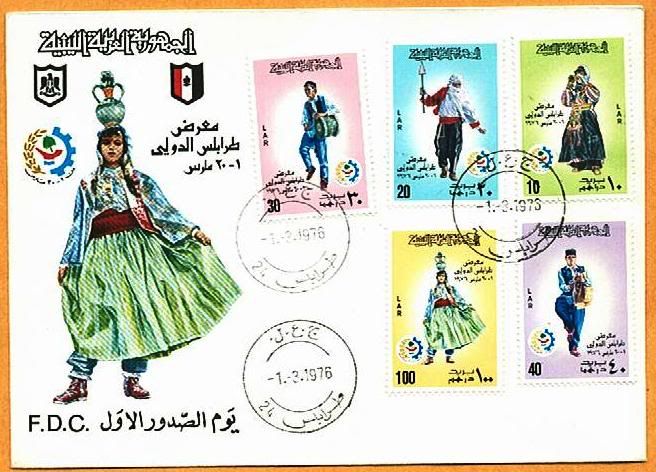
Word from Colonel Muammar Al Gadhafi: 'FORMING PARTIES SPLITS SOCIETIES' - see a Libyan stamp about that, issued in 1984!!! Also, 2 FDCs from Libya. Read from BBC: 'Libyan leader Muammar Gaddafi appears on state TV'.

Read from BBC: 'Libyan leader Muammar Gaddafi appears on state TV'.
http://www.bbc.co.uk/news/world-africa-12533069#

In 1949, George Orwell wrote 'Nineteen Eighty-Four'.
In 1984, this stamp was issued by Libya:

Muammar Abu Minyar al-Gaddafi might not be completely wrong about that...
There could be "democratic" societies that are deeply split, nonetheless.
There could be autocratic societies that are united, for a while, especially if the dictator is "enlightened", truly serving the interest of the nation, as needed.
Not possible, you think?
Read about Cincinnatus, Dictator of the Roman Empire, not corrupted by power:
This image was copied from wikipedia:en. The original description was:
English: Statue of Cincinnatus, Cincinnati, OH, 2004, by Rick Dikeman
"With one hand he returns the fasces, symbol of power as appointed dictator of Rome. His other hand holds the plow, as he resumes the life of a citizen and farmer."

Read from sfgate.com:

One of two Libyan air force jets is guarded by Maltese soldiers in Malta's International airport, Monday, Feb. 21, 2011. Their pilots asked for political asylum amid a bloody crackdown on anti-government protesters in Libya, a military source said.


The two Dassault F1 Mirage air-superiority fighter jets look similar to this:

The pilots defected, rather than delivering air-to-ground superiority upon the protesters, with weaponry like this:
"Armament
  • Guns: 2× 30 mm (1.18 in) DEFA 553 cannons with 150 rounds per gun
  • Hardpoints: 1 centreline pylon, four underwing and two wingtip pylons with a capacity of 6,300 kg (13,900 lb) (practical maximum load 4,000 kg (8,800 lb)) and provisions to carry combinations of:
    • Rockets: 8× Matra rocket pods with 18× SNEB 68 mm rockets each
    • Bombs: various
    • [DORIN'S NOTE: does the fearless leader believe that the protesters will say: Viva variety?]
    • Other: reconnaissance pods or Drop tanks
  • Missiles: 2× AIM-9 Sidewinders OR Matra R550 Magics on wingtip pylons, 2× Super 530Fs underwing, 1× AM-39 Exocets anti-ship missile, 2× AS-30L laser guided missiles"


Descending into chaos...civil war: GENOCIDE ensues.


Eventually, after many protesters will die and enough military will defect, the new military junta (it's possible, is it not?) will deal with the loyalists of The Colonel.
Already, some protesters have special plans for
the (unfortunate?) members of the Amazonian Guard:


"The Amazonian Guard is an elite group of 30-40 (reports differ) virginal women who are tasked with protecting the eccentric Muammar al-Gaddafi.
Their training, as one may expect after some thought, includes both martial arts and firearms.
They have been seen following the fellow around for a few decades. Conspiracies to rape the virgin female guard upon capture of Gaddafi have been rumored during clashes and violence in Tripoli. [1] [2] [3]"
===========
A woman's life in Libya: a balancing act?

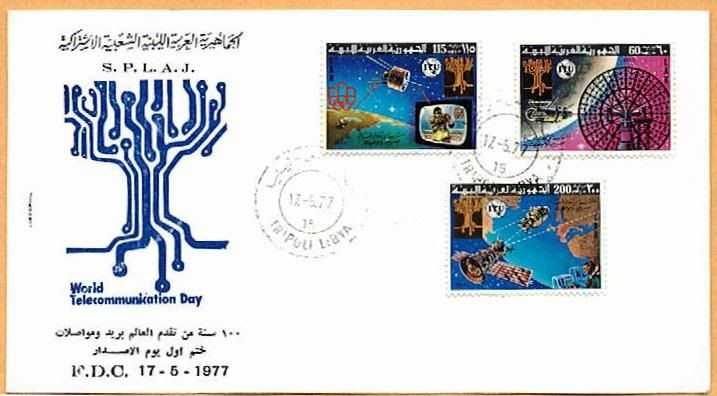
This 1977 FDC is about World Telecommunications Day.
But today's news is GENOCIDE.

Could space-lasers be used against the protesters? Hm...

The boxer above is mistakenly depicted.
Why?
Because he's bare-chested.
So?
It's supposed to be an amateur boxer, in the Olympic tournament.
An A-shirt is mandatory.
Only the professional boxers are bare-chested.

Anyway:
as Gaddafi's son warned, next there could be a massacre. 
He said hundreds of thousands could die.
Libya is a rich country, but 30% of people are unemployed, 66% of those employed live on a few dollars a day...
Meanwhile, dictators around the world amass riches for themselves, at the expense of "the worms", as  Elena Ceaușescu could have said.

When the rabbis became doctors

Milton Himmelfarb was fond of repeating the following joke: "the Jewish people was healthy until its rabbis became doctors," for he used it in Commentary in a 1957 book review, and recycled it in the same periodical in 1974. (In 1957 the sentence continued: "it also was learned and pious until it began to study Jewish history. Nobody was at fault. The rabbis' becoming doctors did not cause but was caused by the Jewish people's losing its health, and the study of Jewish history did not cause but was caused by the loss of the old learning and piety.") The line, he attributes, to one "wit."

Not long ago I saw someone attribute this quote to the Chasam Sofer, which very clearly seemed fallacious. Someone else suggested that it was really a quote from Rabbi Samson Raphael Hirsch. While I agree that it has some of his style, as a suggestion it suffers from the inability of anyone to show in his writings where he said this.

On the face of it, I suspect that it's an American joke. Henry Illoway, son of pioneering 19th century Bohemian-American Orthodox rabbi Bernhard Illowy, writes the following:
In the early days of which we are speaking [i.e., the 1850s] trained rabbis, graduates of universities, were rare south of Baltimore and west of Philadelphia. The incumbents of the ministerial positions were mainly Hazanim , ex-Shohatim, teachers, young men who had looked in upon a Yeshibah but found the acquisition of knowledge of the Torah too onerous a task, and even laymen who or some reason or other sought these positions rather than follow the vocations they were trained to or take up a peddler's pack as did or had done most of their coreligionists. These gentlemen quickly assumed the Reverend and ere long the Reverend Doctor. Wise with his geniality, generous disposition and eagerness to make friends, adherents, followers, for his cause, was very liberal in bestowing the degree of Doctor (which was not specified) upon the few who were too modest or too timid to assume it themselves. An article reviling orthodoxy and its defenders was sure to be so rewarded.
He footnotes a personal anecdote:
The title [doctor] became so cheapened that a few of the more scholarly men who did not hold the degree would not alone not assume it, but even cast it from them. Thus happening one day, a short time after our arrival in New Orleans, to meet in the street the Rev. James E. Gutheim, the minister of the Portuguese Synagogue, I saluted him and adressed him as Dr. Gutheim. Thereupon he said to me; "Young man! I am plain Mr. Gutheim and no doctor!"
This is from pg. 6 of מלחמות אלהים, the 1914 volume titled in English The Controversial Letters and The Casuistic Decisions of the Late Rabbi Bernard Illowy Ph. D. This book is truly fascinating and I recommend all read it.

Speaking of Wise, conferrer of unearned doctorates according to 19th century Orthodox lore, writing in August of 1867 in his own periodical, the Israelite, of the proposed faculty for the formation of a Maimonides College we see the following:
"Rev. Dr. Bettelheim, Professor of Misnah with commentaries, Shulchan Aruch and Yad Hachasakah." [. . . ] this is enough to rouse suspicion. Who is Rev. Dr. Bettelheim? Can anybody who reads Jewish literature tell us, who is Rev. Dr. Prof. Bettlheim? We read, whatever appears in our field both here or in Europe, still we never heard that name. But aside of this, the gentleman is Professor of the Mishnah "with commentaries." Does anybody read Mishnah without commentaries? The man who added the words "with commentaries" knows nothing about the Mishnah or its commentaries. A professor of Shulchan Aruch and Yad Hachasakah. This is ridiculous enough to figure in some Purim play. The Rev. Dr. and Prof. Bettelheim may rest assured, that nobody on this globe ever could boast such a title, and most likely nobody will ever imitate it. The question is, why does the Rev. Dr. Prof. Bettelheim jump from the Shulchan Aruch to the Yad Hachasakah, when we have to it the compendia of Alfas, Tur, Rosh, Rashaba, besides Ran, Beth Joseph, Kesef Mishnah &c. &c. &c. For the sake of novelty, euphony, and aesthetics, we propose to amend the Rev. doctor's title to read thus: Rev. Dr. Bettelheim, Professor of the Mishnah, Bartenurah, Tosefeth Yom Tob, Shulchan Aruch, Shach, Tur, Meirath Enaim, Rif, Ran, Yad, Kesef Mishnah, &c. Tur, Darke Mosheh, Beth Joseph, Rashbo, Rosh &c. &c. &c. and no Chinese in this world could outdo his titles. For the sake of convenience he might arrange them alphabetically, and to save time he might allow students to call him plainly Prof. . . "
And so it continues. (One more point: Wise's next target is Isaac Leeser, who was appointed a professor of Homiletics, Belles Lettres and Comparative Theology. Wise, who couldn't stand Leeser any more than Leeser could him, says that Leeser is almost as meek and unpretentious as Moses, and he will tell you a dozen times in one minute that "he never made any theological studies, and never frequented a university." See here for the saga of Wise and Leeser, and the question of who did or didn't have semicha (rabbinic ordination) and who did or didn't lie about it.

Before I get back to doctors, it's worth posting the following portraits of the aforementioned Rabbi Illowy (1812-1871), and his wife Kathleen (1815-1892), looking very much like Whistler's Rebbetzin.


The portraits were painted in 1862. In case you ever need to know some arcane trivia to impress persons of quality, you can tell them that the answer to the question, Did any of the Chasam Sofer's musmachim (ordainees) where a ring on his finger? is Yes, Rabbi Illowy.

In case anyone is utterly scandalized that an Orthodox rabbi would wear a ring on his finger, here is Samson Wertheimer's wedding ring from 1690:


Note: this ring has nothing to do with a wedding ceremony. However, such fancy schmancy rings were quite common in his time and place. Wertheimer (1658-1724) was a rabbi and a Court Jew. Very rich, very important, and very learned. Incidentally, the illustration was from the first Encylopedia Judaica. The new one with almost no pictures didn't include it.

In addition to the Doctor situation in American Judaism in the 19th century, from poking around I noticed that the quote seems to have made a bit of a splash in sources beginning with Milton Himmelfarb, and thereafter from the 1960s and 70s - mainly Conservative and Reform Jewish sources, citing an old Orthodox joke. Here are some other examples:

Writing in 1983, Rabbi Irving "Yitz" Greenberg said, in an article called In defense of Modernity:
"In the fifties, I changed my name back from Irving to Yitzchak (The Talmud tells: The Jews were liberated from Egypt by merit of not changing their names...You never heard of Abraham, Irving, and Jacob, did you?) I went to Harvard University to get my Ph.D. because every red-blooded American Jewish boy dreamt of going to Harvard and/or marrying a shiksa. After three years there, I wore my kipah publicly (the equivalent of Jews coming out of the closet). And when I received my Ph.D., I insisted on being called Rabbi because the glorification of the doctorate over the Rabbinate was a sign of pathological substitution of outside values for Jewish values. ("When Rabbis became doctors, Judaism became sick."
And:
"Citing Matthew Arnold's principle, let us see how the relationship between individual and society might be formulated for people like us. We are modern, enlightened Jews. Modern, enlightened Jews are those who are not unmodern, unenlightened. The unmodern and unenlightened Jews are those concerning whom we have a tradition, that the Jewish people was healthy before its rabbis became Doctors. Our rabbis are Doctors. For us only polydoxy is orthodox, only orthodoxy is heterodox "(Year book of the Central Conference of American Rabbis, Volume 79 1970 pg. 169).
And:
An old Orthodox Jewish joke: "The Jewish people was healthy, before Rabbis became Doctors." (Himmelfarb again, Commentary 1974)
Again, in Commentary, Jack Wertheimer (1994) quotes a "wag":
"A wag once observed that when rabbis became doctors (of philosophy), the Jewish community got sick. Today, as rabbis become therapists, the community has found itself largely bereft of a superego, in the form of religious leaders willing to articulate what it should and can do."
I have a few other examples, including one from Ismar Schorsch, but they are all basically the same. I did find something that says something very different, yes similar, in 1911. Someone, writing in a British periodical called the Outlook, A weekly review of politics, art, literature, and finance, spoke of "those Rabbis are doctors who prescribe for our Western ailments the petty anachronistic ideas of a Russian ghetto."

Now, it may well be that the place to look is in Yiddish newspapers, but barring that I came across one source that may actually be the origin, or at least a grandfather, of the quote. It is a passage in Shir's 1845 anti-Reform polemic Tokhakhas Megulah ("Open Rebuke"), of all places.

He writes that the Reformers have diagnosed the Jewish people as sick, and they pose as the physicians who can cure them. He says that what actually occurred is that the Jews became sick in the following manner: earlier doctors - the rabbis - had been prescribing to them a sensitive diet and lifestyle to keep them healthy, namely the commandments and lifestyle of the religious Jew - but the patient was ignoring their prescription. So of course they got sick. Now the Reformers came along posing as physicians and said "The Jews are sick," and asked the patients themselves what will cure them. The patients told them, No kosher food, etc. So the physicians, acting as flatterers (enablers we would call them today) began prescribing the very unhealthy lifestyle the people had been living, ignoring the real advice they had received from the real physicians.


Of much amusement is the fact that Shir (Solomon Judah Rapoport) affixed the following motto to the German portion of his books:


At first I thought, "Shir, who are you? Shir writing poetry?" (I know, the irony.) But then I realized that only the title, Die Religions-Reformer, is Shir's. This is an excerpt from a fable by Herder, printed in 1773. The gist is that an old, blind woman lay sick in her home. The doctors were all taking their time to cure her, and since she was blind, each one took some of the furnishings in the home as "payment." Finally she she was cured, but the house was empty. Then they wanted to bill her, so she told them that despite her newly working eyes - she can't see anything.
What does "chashmal" mean?

I have no idea.

Most people know that חשמל (chashmal), the modern Israeli Hebrew word for electricity, was coined by Yehuda Leib Gordon. His inspiration was Ezekiel 1 and 8 which used this word to explain what the appearance of some kind of brightness was like. What does the word actually mean? The Talmud gives two interpretations (Chagiga 13a-b) חיות אש ממללות and עתים חשות עתים ממללות בשעה שהדיבור יוצא מפי הקב"ה. Both of these are wordplay describing angels of some sort, and their activity. Neither of these are particularly useful as definitions in the sense that unless you've seen חיות אש ממללות then telling us that a brightness looks like them isn't so helpful.

As it turns out, the other etymologies that have been suggested are very similar in terms of how it is believed the word was constructed. The Septuagint translated it ἠλέκτρου (elektron) which was Gordon's inspiration. The Greek word ἠλέκτρου, or elektron, meant "amber," not angels. The Latin Vulgate used the word electrum, which is a kind of metal alloy. This doesn't tell us why these translators understood the word to mean these, but one scholar proposed that חשמל is a compound term constructed from נחש, meaning copper, and מללא, an Aramaic term for gold. On מללא as gold, see Kes. 67a, where Rashi explains it as gold leaf, and Tosafos as gold ore - I was curious how Artscroll would translate it, and they say "gold dust" on the authority of Rashi, but I think they totally misunderstood him. Even though I think the simple sense of his words are "gold leaf," I would be less confident in myself if not for the fact that Rashi translates it into French and he very clearly says "leaf" - פלאל"א. Even an English speaker should be able to figure it out just by how it sounds. But as it turns out, the modern equivalent "feuilles" means "leaf." Dust, or "poussière" is simply not close enough. Soncino gets it right.

In any case, Gordon used chashmal in a brilliantly titled poem, which he completed in 1883, called שְׁנֵי יוֹסֵף בֶן שִׁמְעוֹן, an epic about communal corruption and identity theft. To make a long story short, a really diligent, good Talmudic child prodigy goes to Padua to learn Torah and medicine. In the meantime, a horse thief named Uri pays off a communal official to write a passport for him under the name of the missing student. When the student returns to Russia, he is arrested for a murder committed by Uri, who's been using his name, and sentenced to exile for life in Siberia. In the 5th Canto, Gordon describes the youth's studies in Padua, and correlates all sorts of sciences with traditional terms and concepts. For example, tuma ve-tahara is related to hygiene. The ma'aseh bereshis and ma'aseh merkava are correlated with natural science, and in the course of it he refers to kabbalistic terms which are forces of nature, one of which is chashmalah. Although this would no doubt have escaped the reader, he clarified in a note that he meant electricity - "כוונתי להכוח הטבעי הנקרא עלעקטריציטעט, שכן תרגום היווני של חשמל הוא עלעקטרא," "My intended meaning is the natural energy called electricitat, as in the Septuagint translation of chashmal as elektra." Others, no doubt, have charted the spread of this term thereafter. Gordon himself thought that the term could even be extended in yet another compound wordplay, since חשמל could also be thought of as a compound formed from חש מל, the first meaning "quick" (as in Isaiah 8:1) and the latter stemming from מלה, or word. In other words, quickword, or telephone (or perhaps telegraph). Obviously חשמל was only accepted for electricity.

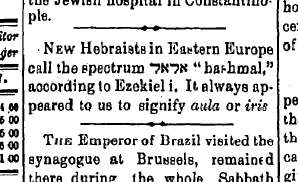
Since the word appeared after 1883, was the word used in any other sense in modern Hebrew writings before or around the same time? I don't know, but maybe. Here is a short blurb in the November 11, 1887 issue of the American Israelite:


I have a problem here. The Hebrew says אלאל but the transliteration is "hashmal." I don't know where the mistake is, but assuming it's just a Hebrew typography mistake, then the writer of this blurb (probably Isaac Mayer Wise) is saying that some modern Hebrew writers are using chashmal in the sense of spectrum, which makes sense in a roundabout way. The Latin word for the copper-gold alloy mentioned earlier is aurichalcum, a word which is related to aurum, or gold. Perhaps these unnamed Hebraists thought that aurum was related to iris, or rainbow in Latin.

A final note: it's interesting that the word for electricity in modern Arabic was also purloined from the word which formerly meant "amber," and for the exact same reason, albeit a little earlier (and clearly unknown to Gordon). Rifa'a el-Tahtawi (1801-1873) is generally given the credit for expanding a preexisting term for amber to include electricity, because of the Greek ἠλέκτρου which, after all, is where the European forms of the the world electricity came from.

Ultimately there was little rhyme or reason for calling it electricity in the first place, other than the European penchant at the time for writing learned works in Latin. See here for the etymology of "electricity." Since it was an English scientist who in fact coined the term, because of the attractive powers or amber, I suppose he could also have called it ambericus instead of electricus. Francis Bacon is credited with introducing it into English a little later, as electric - he could have used amberic.

A final final note: not surprisingly the fact that the modern Hebrew term comes from the loftiest, most esoteric part of the Jewish tradition, and the fact that Yehuda Leib Gordon was a radical maskil inspired rejection of his term on the part of many traditionalists who do not call electricity chashmal in Hebrew to this day. They call it . . . electricity.