Why are there Jewish dietary laws? Maimonides conjectured that the reason for the dietary laws is mostly for health and hygien (Guide iii.48, see below):


By the 19th century the premise that "there is nothing among the forbidden kinds of food whose injurious character is doubted, except pork and fat" was itself doubted. In Samuel David Luzzatto's
Yesode ha-Torah (below) we find the rejection of a connection between
kashrut and health. He offers a proof for this being that camels aren't kosher but Arabs eat them without any injurious result; on the contrary, it is an excellent source of nutrition for them.

Instead, Luzzatto explains that the point of prohibited foods is to promote separateness and holiness, not for this or that specific thing being prohibited, so long as
some foods are prohibited.
The eessence of this argument was already made at the end of the 17th century by
Isaac Fernando Cardoso, a Marrano physician who left the Iberian peninsula to join the Jews of Venice. He wrote a classic of apologetic Jewish literature on "The Excellence of the Hebrews," (
Excelencias de los hebreos).

I haven't seen the book, but Yosef Hayim Yerushalmi writes that his discussion of
kashrus is on pp. 39 to 45 of this book. He summarized Cardoso as explaining that there were two opinions regarding the reason for the dietary laws. One is that of Maimonides and the other is found in the
Letter of Aristeas, where Eleazar the High Priest explains to Ptolemy that the significance is purely symbolic. Below is from Thackeray's translation of the Letter of Aristeas:


Cardoso adds a third reason, that eating food which is not kosher engenders a bad temperament, which blocks understanding and leads to contamination of thought, brought about by contamination of spirit. I do not know where this view is advanced, unless this refers to the kabbalistic concept of
טמטום הלב. Perhaps it is a view of his own (although he will reject it).
Cardoso, the physician, rejects any medical explanation, for a few reasons. First, to claim that the dietary laws are really a kind of manual of health demeans God, because guides for healthy eating are found in any medical text, while God's laws are wisdom which cannot be obtained elsewhere. Furthermore, it is obvious that generally speaking Gentiles are no sicker than Jews although they eat those foods. (Yerushalmi reminds that Cardoso knew this from personal experience.) Additionally, foods which are considered unhealthy by medical science (such as cucumbers, mushrooms and onions) are permitted by the Torah. Finally, the Torah calls such forbidden foods
unclean or
impure, not
unhealthy.
While rejecting the idea of some kind of medical reason for kashrus, it should be noted that elsewhere in the book (pg. 348) Cardoso attempts to refute a popular antisemtic claim that Jews suffer from particular defects and maladies. Here he claims that Jews are really generally
healthier than the general population. In support he cites Buxtorf, that Jews are less prone to leprosy because of
kashrus, but also subjects Buxtor's complete view of this issue to critique. It is worth reproducing Buxtorf's complete chapter (translation by
Alan D. Corré ):
About the Sicknesses of the Jews
Many people believe that Jews live longer than Christians, and do not have as many diseases among them as Christians. Experience teaches, however, that they die just as young as other peoples. So we also know from experience that they suffer from Chicken Pox, Measles, Epilepsy, and Cholera, and they have among them other diseases, just as much as other peoples.
They call epilepsy Choli hannophel. [falling sickness] They very commonly curse one another with this disease and say: "Der Schem (das ist: God) gebe dir Choli nophel, oder den Tippul." ["May God give you epilepsy – or its treatment." I think B. misses the point of this humorous curse, because the treatment, of course, is death.]
They call cholera Hilluch. [An abbreviation of hilluch me'ayim, "bowel movement."] They curse one another and say: May the hilluch overtake you. At the time of cholera they write strange characters and wonderful names on their houses, rooms and apartments. They say they are the names of the angels who are appointed over cholera. I once saw on their houses in big letters Adiridon, Bediridon etc. with the ending "diridon" appended to every letter of the alphabet, as well as some words in Hebrew script. They believe this to be a powerful remedium for cholera.
To be sure, leprosy is not so common among them as among Christians, partly because their numbers are few compared with Christians, and partly because they are more abstemious in respect of many foods and other things which can bring about this condition. So far as possible, they conduct themselves with regard to food according to the Law of Moses, but in nothing are they so obstinate as in the avoidance of the flesh of the pig. They will not, and cannot, even hear about it, and would rather die than eat it. However, some of them are afflicted with this disease, leprosy, as Anton Margarita testifies that there were some Jewish lepers at Prague. The Old Testament proves that it was common among them. They call it Nega, plague, and curse one another: May the Nega seize you.
Cardoso is a physician, Buxtorf was not. Thus, he knows more about the subject, and although he is happy that Buxtorf reports that Jews suffer from less leprosy and therefore cites him, he should have known that they also suffer less from the other diseases mentioned. Furthermore, Cardoso reports that even gentiles ascribe
cleanliness to kosher food, and so in Venice they order meat from the Ghetto markets, being that the meat is from animals that did not die naturally, is without disease and also without blood. This is interesting because insofar as cleanliness relates to health, does this not undermine his whole argument?
Not directly related to this post, but it is interesting that Cardoso allows that it may be that there is one illness which Jews suffer from more than gentiles: melancholia. This he ascribes to the bitterness of exile.
In any case, in his
Excelencias he does not really accept any of the proffered reasons for the dietary laws, pointing out strengths and flaws in them all, but mostly accepting that they are God's wise laws. As you can see, his approach is a precursor to Shadal's. You can't say that various animals are forbidden because they aren't healthy, for that is not at all established. On the contrary, the evidence indicates otherwise.
Interestingly, in R. Leone Modena's
Riti numerous pages are devoted to explaining what the dietary laws are, but there is not one word of suggestion toward an explanation for them, except at the end, where the rabbinic prohibition of eating meat and fish together is given as due to a health concern, "
but that is not observ'd now-a-days."
Thus for Jewish approaches to the dietary laws. Christians, on the other hand, had to grapple with dietary laws being found in the Old Testament, that is they are the Word of God, but also somehow no more applicable. With that in mind, health and hygiene were offered as probable reasons, but since the dietary laws themselves were no longer applicable, it was reasoned that the health benefits were also from the remote past (e.g., suited for the wilderness, or the climate of ancient Israel).
In the early 19th century the dietary laws became highly unpopular among a certain segment of reform-minded Jews and non-Jews for they were perceived as a major barrier to Jewish emancipation and integration. Charles-Joseph Bail, the Napoleonic administrator of the Kingdom of Westphalia wrote a book decrying the intolerance and discrimination against Jews that he found in Westphalia. However, like all liberal non-Jewish opinion of the time, this defender of the dignity of the Jews also assumed that the Jews must reciprocate and reform Judaism. With that in mind, he evidently described the laws of
kashrus as vestiges of ancient hygienic practice, and therefore unnecessary in the 19th century.
Responding to his call for reform of Judaism in 1817, Rabbi Abraham Vita de Cologna
wrote a reply in the form of a pamphlet, headed by the motto
Erit amicus Plato, sed magis amica veritas ("I love Plato, but I love Truth more" - a post about this phrase in Jewish tradition will be forthcoming) as follows:

The meaning of the passage can be conveyed well and most interestingly by an English translation from 1833 that is found in Isaac (father of Benjamin) D'israeli's book
The Genius of Judaism:
The camel is an interdicted animal and as we know that its flesh yields a nutritious and even delicate meat among the Orientalists, the great legislator must have had some more important motive in prohibiting the use of these animals as food ; and therefore we must infer that the distinction between clean and unclean animals must originate in a higher and more occult source.
This is Shadal's objection to the hygiene approach, or rather, this 1817 pamphlet is Shadal's source for his objection.
Shadal is normally meticulous to the point of distraction in citing sources, but
Yesode ha-Torah was meant to be a simple, fluid book, and I assume that is why he did not cite him, unless he simply forgot the source or somehow arrived at it independently. But Cologna was personally known to Luzzatto in Trieste, and admired by him. He is quoted in several places in his Torah commentary, and always wrote extravagantly of him whenever mentioning his name. In addition, he considered his brother R. Angelo (Mordechai) Cologna to be one his primary
rabbeim. It is thus all but certain to me that the 1817 pamphlet was where he acquired the point about Arabs eating camel flesh as a refutation of Maimonide's view.
R. Cologna was a Very Important Jew early in the 19th century. He was among the three leaders of the Parisian Sanhedrin of 1806 (R. David Sinzheim was titled
President, or
נשיא. R. Sauveur Benoit Segre was titled
premier Assesseux, or
אב בית דין, and Cologna was
deuxieme Assessuer, or
חכם). He had been the Chief Rabbi of Mantua, and as a result of his Parisian experience, was knighted by Napolean
[1] and became the Chief Rabbi of Paris. After some years in this position he became the Chief Rabbi of Trieste after it's incumbent R. Avraham Eliezer ha-Levi died. The astute reader will recall that Rabbi Abraham Belais sought Cologna's
haskamah as well as R. Moshe Sofer (
link).
Here is his biography in Rabbi Marco Ghirondi's
Toldos Gedolei Yisrael:

Here's a poem written in his honor by Shmuel Chai Zelman, published in
Bikkurei Ha-Ittim 11 (1830), on the occasion of his move to Trieste:

Here's what is written on his tombstone:

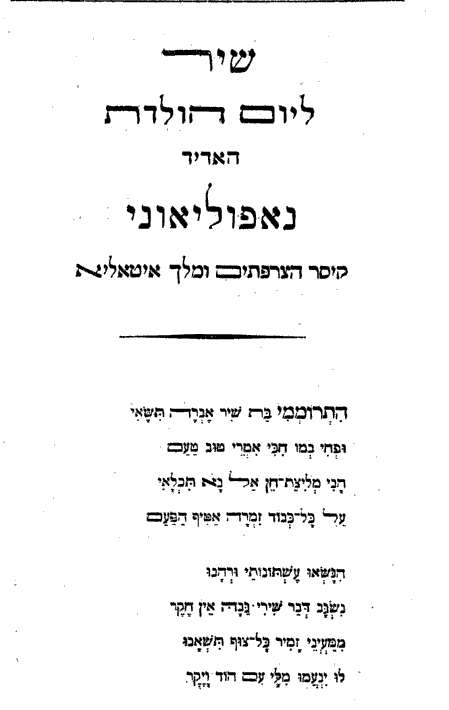
Part of a poem he wrote in honor of Napoleon's birthday:

Here is the final page of the Hebrew-French edition of the
Decisions Doctrinales of the Sanhedrin published in Paris in 1812:

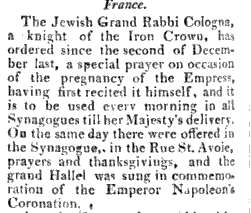
A notice from 1811 about a Hebrew prayer composed by him for the pregnancy of Napoleon's wife, meant to be recited daily until her Majesty's delivery:
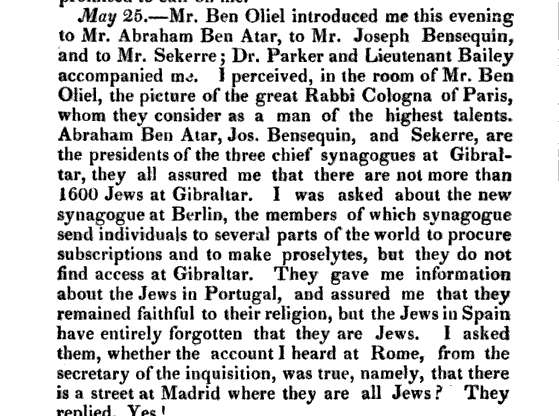
In the 1820s, the missionary Joseph Wolf wrote the following about his visit to Gibraltar; Cologna's portrait could be found on the walls of the Jews there:
An image of some of the members of the Sanhedrin:
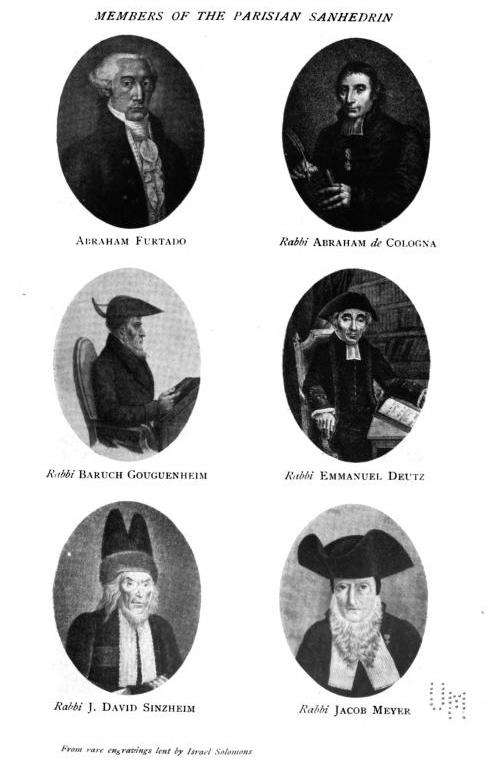
Here is a larger picture of the
Chevalier himself:

Strangely, there is a Neturei Karta connection. Before I could even draw the following connection,
Neturei Karta already did. In 1825
Mordecia Manuel Noah, aprominent Jewish American, hatched a plan to create a Jewish refuge called Ararat in
Upstate New York. He tried to enlist support among fellow Jews, including such prominent Europeans like our Cologna, British Chief Rabbis Hirschell and Meldola, and Leopold Zunz, but ultimately got nowhere, which hardly needs to be said. Perhaps Noah's approach of appointing individuals to positions without asking them first -- he wished to make Cologna Secretary of Emigration -- was not the most diplomatic.
The
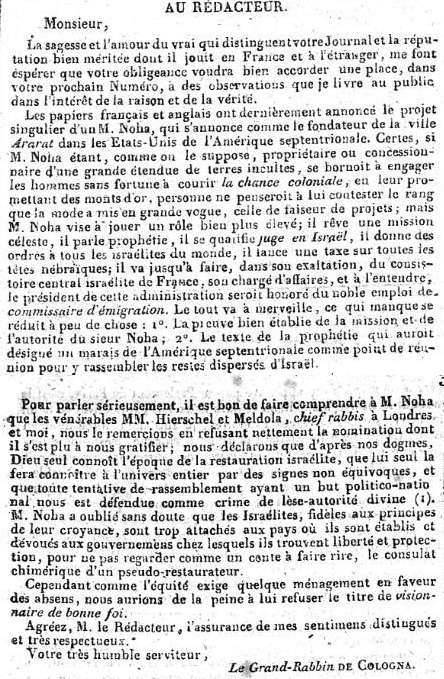
Journal des Débats printed Cologna's reply to Noah in its November 18, 1825 issue. So significant is this reply (and/ or obscure is the
Journal des Débats today) that simply putting those words into Google returns, as its third result, a translation of this letter at
Nkusa.org, ascribed to "the Chief Rabbi of Cologne". This is a fabulous example of the citation of rabbis who say something potentially supportive of one's position, without having the slightest idea of who it is one is citing. This is hardly unique to Neturei Karta.
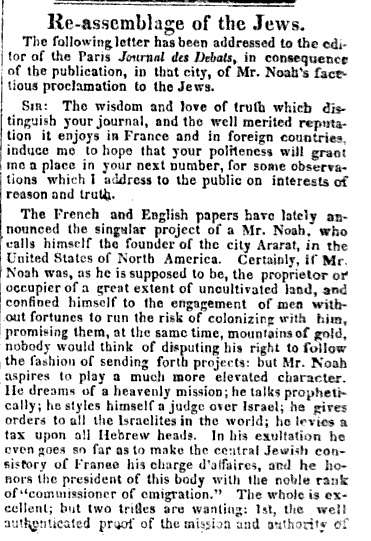
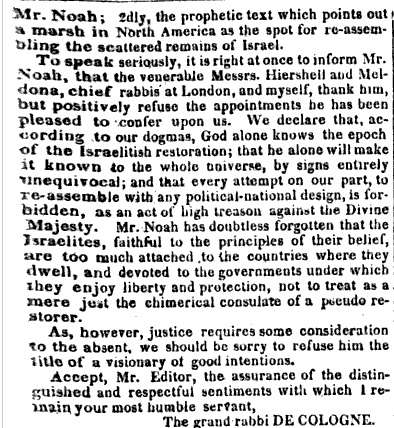
Below is the original and an English translation published in an American periodical called Niles' Weekly Register:
Here's the Neturei Karta translation:
To the Editor:
Dear Sir:
The wisdom and love of truth that characterizes your Record, and the reputation that it enjoys in France and abroad give me hope that you would be kind enough to provide space in your next issue for my comments offered to the public in the interest of accuracy and truth.
The French and English newspapers have covered in detail the unique project of one Mr. Noah, who claims to be the founder of the city of Ararat in the northern part of United States of America. Of course, if Mr. Noah is supposedly the owner or lessor of a great amount of uncultivated land to enable people lacking wealth to find their fortune in a colony, offering them mountains of gold, no one would ever think of disputing his position that is currently very popular, and prevent him from undertaking his projects.
However, Mr. Noah intends to play a much more important role because he is dreaming about a celestial home, he pronounces prophecies, and considers himself a Jewish judge. He gives orders to all the Jews in the world, and is trying to impose a head tax on all Jews. In all of his excitement, Noah goes so far as to try to create a central Jewish council in France. His chief administrator would have the honor of the noble role of “minister of emigration.” This tremendous effort considers its deficiencies of little importance: 1) the well-established “proof” of Mr. Noah’s authority; 2) the text of his prophecy demonstrating North America as the location where the Jewish Diaspora is supposed to gather together.
In all seriousness, though, it is proper to inform Mr. Noah that the esteemed Mr. Hierschel and Mr. Meldola, chief rabbi of London, and I thank him by completing [sic]rejecting the appointments that Mr. Noah wishes to offer us. We state that according to our religious teachings, only G-d Himself knows when the redemption of the Jewish People is to occur, and it is only G-d who will make His will known to the entire universe with unmistakable signs. Any attempt to gather together the Jewish People with political and nationalist goals is forbidden to us as a crime of the highest divine authority. Mr. Noah has surely forgotten that Jews are loyal to the principles of their faith, that they are too attached to the native countries where they reside and too devoted to their governments providing them with liberty and protection to pay attention to a fairy tale and fantasies of a false redeemer.
Therefore, since fairness demands discretion on behalf of those absent today, we would feel bad to deny him the title of Visionary of Good Faith.
Please accept my wishes,
Your very humble servant, The Chief Rabbi of Cologne
As you can see, speaking on behalf of himself and Rabbis Hirschell and Meldola, he said, no thanks.
Getting back to the kashrut-health-hygiene question, this generally was a connection made only in the early 19th century. By the
end of that century no one really lodged it anymore, at least not on the Jewish side, except to apologize
for kashrus or to grant a point in favor of tradition, but to show it as something which wasn't crucial. Thus, Lilian Helen Montagu writes the following in her
Thoughts on Judaism:

However, for her "the legal minutiae added by the rabbis" have distorted whatever good there is in kashrus, and thus the laws should be "reverently examined" and where in accordance with "hygienic truth" and human treatment for animals, should be given our allegiance.
Writing in 1896, C.G. Montefiore stresses that kashrus is superstition, not hygiene. It is Asiatic, and not European. Furthermore "it is impossible for persons of culture to keep the Dietary Laws." It is worth reading his article and Hyamson's reply, "Another Word on the Dietary Laws" in the Jewish Quarterly Review.
Here's a typical sort of treatment about it from 1912:

In Isaac Mayer Wise's autobiography, he printed a letter as follows:


In short, by century's end everyone was too smart and too sophisticated to claim that the Mosaic dietary laws were a healthful measure. However, early in the century the Rambam's explanation had been more popular.
[1] Cologna's knighthood (hence, his title
Chevalier) was something many Jews were quite proud of. In the
Voice of Jacob October 14, 1842 we find:
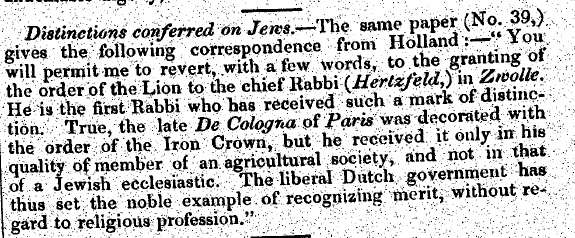
I have no source other than this, but the claim here is that he was knighted for something entirely unrelated to being a rabbi. I have no idea if this was meant to be a loophole, that is, if Napoleon's
Order of the Iron Crown precluded knighting a Jew for his Jewishness, or not. In any case, the order had only 100 members (of three different ranks), and would thus seem to have been quite an honor.


